
Managing the labyrinth of complexity
Risk Principle(s): Complexity navigation; internal threats; governance frameworks
Key Lessons: Complex systems need clear strategies. The Labyrinth represents complexity; the Minotaur, internal threats. Plans, courage, and traceability to overcome entrenched issues.
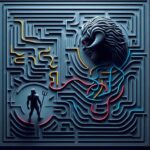
In the annals of Greek mythology, heroism often involves not just physical prowess, but cunning, strategy, and the courage to confront the monstrous. These ancient narratives, brimming with psychological depth and strategic dilemmas, offer remarkably potent insights for the modern world of risk management and governance.
At Imergo, we believe in the power of storytelling to transform abstract risk concepts into relatable, memorable lessons, fostering a culture of strategic foresight and courageous problem-solving. Let’s venture into the legendary tale of Theseus and the Minotaur, a myth that vividly illustrates the challenges of navigating complexity and confronting hidden, formidable threats.
Theseus and the Minotaur: A masterclass in navigating complexity and confronting internal threats
The harrowing myth tells of King Minos’s monstrous son, the Minotaur, a terrifying beast housed within the impenetrable Labyrinth. To appease Minos, Athens sent yearly tributes of youths to be sacrificed. The hero Theseus volunteered, determined to end this horror. His success hinged not just on strength, but on strategy: with the help of Ariadne, he acquired a ball of thread, which he unwound as he entered the Labyrinth, ensuring a path back out after defeating the Minotaur.
The Risk Lesson
The Labyrinth is a perfect metaphor for the overwhelming complexity found in modern enterprises – intricate processes, convoluted regulations, and opaque reporting structures.
1. The “designed” failure of complexity: Labyrinths in business are rarely natural; they are built over time through siloed growth, technical debt, and “patchwork” governance. Without a clear methodology – our version of Ariadne’s thread – even the most capable leaders can become lost. Inefficiency, miscommunication, and strategic paralysis are the inevitable results of a system where the “path” is no longer visible to those walking it.
2. Confronting the “Monster” of Internal Rot: The Minotaur represents the deeply entrenched, often monstrous problems that lurk within an organisation’s shadow. These are the “beasts” that consume resources and undermine morale:
- Toxic company culture: A monster that “eats” your best talent.
- Legacy systems: Technical debt that drains funds and prevents innovation.
- Fraud vulnerabilities: Hidden gaps in controls that allow value to leak away. The greatest risk is not the existence of these monsters, but the institutional habit of “feeding” them tributes – sacrificing time and money to keep the status quo – rather than confronting them head-on.
3. Governance as “Ariadne’s thread:” Theseus’s success was guaranteed by his traceability. In a risk context, the thread represents:
- Clear methodologies: Standardised ways of approaching complex problems.
- Auditable trails: Knowing exactly how a decision was made and how to “trace back” to the source.
- Exit strategies: Having a pre-defined “way out” of a project or investment if it proves unviable. If you enter a “labyrinth” (a new market, a merger, or a digital transformation) without a thread, you aren’t being a hero; you are being a sacrifice.
The boardroom perspective: The courage to go inward
Unlike external invaders, the minotaur was a monster of Minos’s own creation, hidden and contained to avoid public shame. Similarly, organisations often face their gravest threats from within – issues that are difficult to confront because they are culturally sensitive or require significant internal upheaval.
Addressing these “internal minotaurs” requires leadership courage. It is often easier to focus on external competitors than to admit that your internal processes are broken. However, true strategic resilience requires leaders who are willing to “enter the Labyrinth,” shine a light on the monsters, and simplify the complexity that hides them.
Strategic action: From maze to map
To move beyond the myth, leaders must commit to three core pillars of clarity:
- Audit for complexity: Regularly “map” your processes. If a reporting line looks like a maze, simplify it before a risk hides within it.
- Empower the “truth-tellers”: Ariadne gave Theseus the tool he needed because she saw the danger clearly. Foster a culture where people can flag “monsters” without fear of being the next sacrifice.
- Mandate traceability: Ensure every complex strategic move has a “thread” – a clear plan for monitoring progress and a defined exit strategy.
By internalising the lessons of Theseus, leaders can equip their organisations with the clarity and courage needed to navigate any complexity and overcome even the most formidable internal “monsters.”