
If you find yourself wandering the sun-drenched, winding streets of Funchal, Madeira, you might stumble upon a grand, weathered industrial building known as the Casa da Luz. Inside is the Museum of Electricity – a quirky sanctuary where a “dry” utility is transformed into a story of human progress and safety.
It begs a fundamental question for our modern age: If we can have a museum for the wires behind our walls, why don’t we have one for the invisible force that governs our entire lives? Why is there no Museum of Risk?
Risk is the silent variable in every car journey, pension fund, and global supply chain. It is the history of the shadow factories that built the Spitfire, the mathematics of the 2008 crash, and the psychology of why we take leaps of faith. Yet, we treat it like a footnote in a textbook or a dull line in an insurance policy.
In a world defined by AI-driven uncertainty and climate tipping points, I believe it is time we move risk out of the boardroom and into the public eye.
The appetite for the unusual
We are clearly a species fascinated by niche outcomes. In Stockholm, Vrak – Museum of Wrecks uses VR and holograms to let visitors explore “marine cemeteries” on the floor of the Baltic Sea. Meanwhile, the roaming Museum of Failure celebrates everything from purple ketchup to the Titanic, arguing that we must accept failure to achieve progress. Other niche institutions exist, or are planned, like London’s upcoming Insurance Museum.
These institutions are brilliant, but they focus on the results: the sunken ship or the product flop. What is missing is a home for the process. We have museums for what went wrong. There is currently no single physical space that synthesises the entire discipline: we don’t have a “living laboratory” for the mechanics of uncertainty and the science of probability.
The Concept – The “must-see” gallery: making the invisible tangible
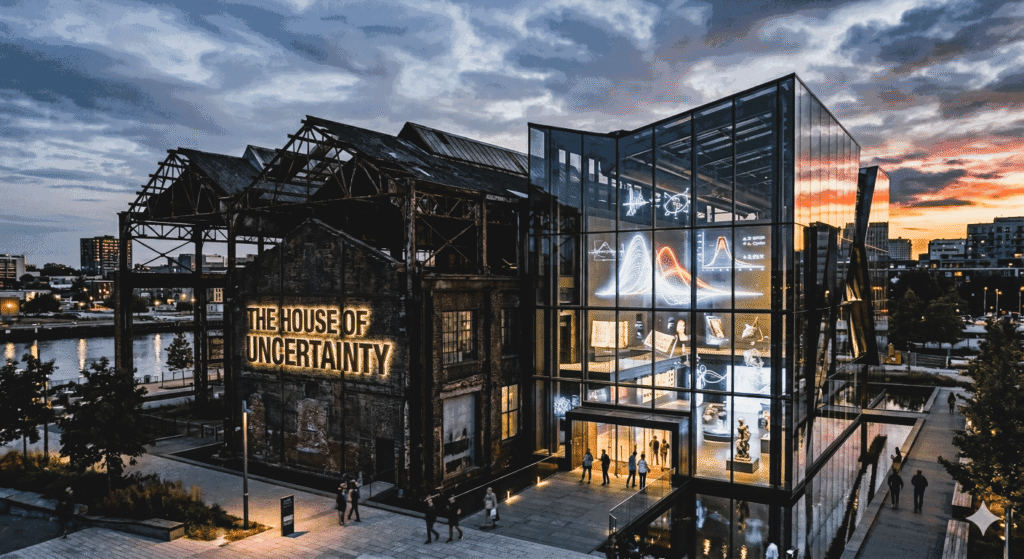
What if we created a space – let’s call it “The House of Uncertainty” – where the science of probability meets the art of the human heart? A place where we don’t just archive the past, but decode the future. What would such a museum hold?
- The Titanic’s “Binocular Box”: A replica of the locked cupboard that held the binoculars the Titanic’s lookouts couldn’t access because the key was missing. It is a haunting example of latent failure – how a tiny, overlooked risk can lead to a massive catastrophe.
- The 17th Century Lloyd’s Ledger: A replica of the records where modern risk transfer began with ink, paper, and the personal fortunes of underwriters betting on a ship’s safe return.
- The “Trolley Problem” Lever: A heavy, iron railway signal lever. This would be the anchor of the Ethics Room, inviting visitors to pull the lever and simulate the famous moral dilemma: Do you kill one person to save five?
- The Deepfake Mirror: In the Emerging Risks Gallery, an AI-powered “smart mirror” alters your face and voice in real-time, highlighting the new frontier of Reputational Risk in the digital age.
From Education to “Edutainment”
A Museum of Risk shouldn’t just be about looking; it should be about doing.
Drawing on the philosophy of experiential learning, the museum would feature a Risk Management Escape Room. You and your team are locked in a room representing a business in crisis. To get out, you don’t just find keys; you must analyse “Single Points of Failure” and develop a mitigation plan under a ticking clock.
And when the adrenaline fades? You head to the Risk Café. Here, every dish has a colour-coded “Risk Rating” based on live data: ingredient freshness, allergen profiles, and even “spice probability.” It’s the only café in the world where ordering a sandwich is a lesson in personal risk tolerance.
Conclusion: The House of Uncertainty
Ultimately, a Museum of Risk is about the Moral Compass. Unlike the Museum of Electricity, which shows us how we harnessed physical power, a museum of risk shows us how we harness ourselves. It asks: What do we value most? Profit? Safety? Progress? Or each other?
We are living in an era of “Poly-crisis” – climate change, AI, and global instability. We can no longer afford to leave risk to the “experts” in the back room. We need a place to poke it, prod it, and learn to navigate the grey areas of our future.
Madeira has its “House of Light.” I think it’s time we had a “House of Risk.” Because in a world of uncertainty, the biggest risk of all is not understanding it.